
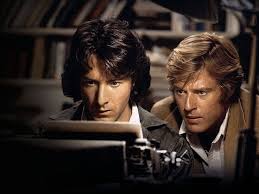
How did Bob Woodward and Carl Bernstein actually uncover the Watergate burglary linked to President Richard Nixon? Remarkably, released just four years after the Watergate scandal, Alan J. Pakula’s All the President’s Men (1976), based on the book of the same name, tells the true story of how two brave Washington Post reporters cracked the case.
I was initially apprehensive going into the film. It’s a two-hour-and-twenty-minute movie released in the late seventies about newspaper reporting, and one where the ending is already known. However, All the President’s Men does an incredible job of building tension and keeping you engaged. Its dim lighting, tight close-ups, and a constant sense of unease make the film feel like a psychological thriller, mirroring the paranoia of the Watergate era. It’s clear how this film was the start of the “investigative journalism” genre, inspiring later movies such as Zodiac (2007) and Spotlight (2015). The film also becomes much more than a simple retelling of Watergate, emerging as a story about resilience and the importance of truth, even in the face of immense pressure and threats to stop the truth from coming out.
While it may seem like anyone could play the role of two ordinary journalists, Dustin Hoffman and Robert Redford, who portray Bernstein and Woodward, respectively, give subtle yet powerful performances as two young reporters determined to uncover the story. The highlight of the film, however, is Hal Holbrook as Deep Throat (yes, that’s his actual code name), a mysterious informant who speaks in cryptic metaphors and meets Woodward in dark parking garages. Every scene with him is captivating and eerily suspenseful.
The film is also a great representation of the 1970s. Released at a time when public trust in government was at an all-time low, its message felt especially powerful and relevant to the era. It does an amazing job of demonstrating the power of journalism in revealing the truth, and it helped shape the public’s perception of reporters as heroes capable of holding our leaders and the powerful accountable.
The film’s biggest flaw, however, is how over-stuffed it is with information. While it’s impressive how historically accurate the movie is and how thoroughly it captures the painstaking process of investigative journalism, the sheer volume of information can be exhausting. There are so many names, connections, and plot threads to keep track of that the story can be hard to follow at times. The reporters also run into multiple dead ends, such as the scene where Woodward and Bernstein sit at their desks, dialing name after name in silence, only to hear the same click of a hung-up phone each time. While moments like these actually occurred and illustrate how difficult and draining investigative journalism can be, there are too many for a film that’s under two and a half hours. Some feel redundant and make the story confusing, while their impact would have been just as strong if a few had been cut. Although this complexity is clearly intentional in reflecting the urgency, frustration, and chaos of the real investigation, the movie sometimes seems to cram every single detail of the Watergate scandal into too little time. I actually preferred the slower, quieter moments, like when the journalists struggle to draw information from reluctant sources. Going in, I worried these moments would be boring, but they ended up being my favorites since they revealed the reporters’ persistence and humanity far better than the fast-paced sequences packed with information dumps.
Even after almost 50 years, All the President’s Men keeps you on the edge of your seat, shows how messy and thrilling real-life reporting can be, and makes you appreciate brave journalists like Woodward and Bernstein. This is a must-watch for everyone—just be prepared to remember a lot of names!
Rating: 8.5/10






Steve • Feb 22, 2026 at 2:46 pm
I’m glad you watched and enjoyed the film, as its significance hasn’t waned since its release. However, I have to disagree about the films “biggest flaw”. All these names, references and connections were being reported on at the time. When this movie was released more people generally kept up with the news and knew what the film was referring to. Now 50 years later, prying into the Watergate Scandal through the lens of this one film, only tells a piece. Additional reading is required to fully understand the depth of the scandal. It’s like watching an SNL episode from 10, 20, 30 years ago. Pop culture references are made, but if you weren’t alive for them you won’t fully understand them. Appreciate the review!