
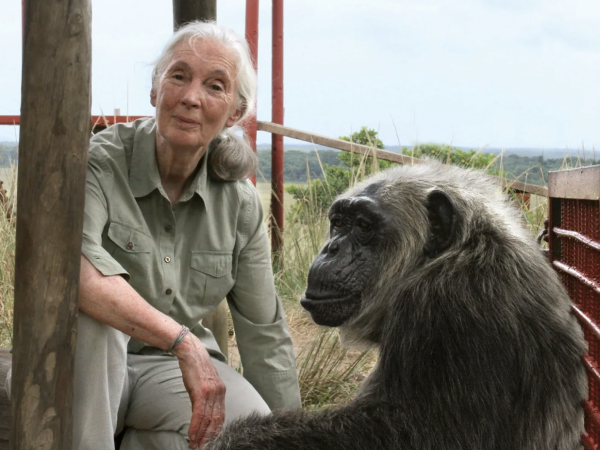
The world mourns the loss of Jane Goodall, the pioneering primatologist whose groundbreaking research transformed our understanding of chimpanzees and inspired generations of conservationists. She passed away on October 1st due to natural causes, leaving behind a legacy of unwavering dedication to our natural world.
Her journey in primatology began long before her research in Tanzania. Born Valerie Jane Morris-Goodall, she developed a fascination for animals early on in her life. In an interview with National Geographic Kids, she recalled, “I was ten when I decided I wanted to go to Africa and live with wild animals and write books about them.” According to the book Who Is Jane Goodall, her love for animals sparked when she received a stuffed chimpanzee from her father at the age of one. It was called Jubilee, named after the first chimpanzee born at the London Zoo. Jubilee was her cherished companion. She grew up in an extremely supportive environment where her parents often encouraged her curious nature. She would spend time observing animals, going as far as to sit in her family’s henhouse for hours to watch a chicken lay an egg. Her interest in animals was also fueled by books like Tarzan and Dr. Dolittle. She dreamed of a life in Africa like the characters in her storybooks, and when she was 23, her dreams began to take flight.
In 1957, she moved to Kenya. There, she met Louis Leakey, a renowned anthropologist who quickly recognized her potential. He invited her to study chimpanzees at a park in Tanzania called Gombe Stream National Park. As reported by the Natural History Museum, at the age of 26, she embarked on a new journey—one that would mark the beginning of her transformative research which changed our understanding of human evolution forever.
Unlike most researchers at the time who simply observed from a distance, Jane immersed herself in the environment; over time, she was able to build trust with the chimpanzees and learn to live among the harsh conditions of the forest.
Her day to day life was extremely difficult. She endured extreme climatic conditions and several outbreaks of malaria. Each time she contracted the illness, she refused to leave. She reflected, “When you meet chimps you meet individual personalities. When a baby chimp looks at you it’s just like a human baby. We have a responsibility to them.” Her resilience in the rainforests became a hallmark of her career and many were inspired by her abilities to thrive in those conditions.
Her observations at Gombe changed how scientists viewed and understood chimpanzees. She discovered that they use tools to fish termites from their mounds. Behavior like this was previously thought to be uniquely human. She also learned that they hunted other animals such as smaller monkeys, antelope, tortoises, and birds, contradicting the assumption that they were herbivores. Also, like humans, chimpanzees are able to form intricate social bonds. She recorded all of her findings and even gave each chimpanzee a name. She said that, “by naming them, [she] hoped people would see them not as animals, but as beings with personalities and feelings.” Her insights changed primatology and made scientists reconsider what it means to be human.
Jane Goodall was also a passionate advocate for wildlife conservation and welfare long after she returned from Africa. In 1977, she founded the Jane Goodall Institute, focusing on wildlife research, conservation, and education. She launched the Roots and Shoots program, which aimed to empower the youth to take action on behalf of the natural world.
Her efforts earned her many awards, including the Templeton Prize in 2021 and the Presidential Medal of Freedom in 2025. She remained an active voice for environmental issues up until her death.
Her enduring message is one of extreme importance; she famously said, “You cannot get through a single day without having an impact on the world around you. What you do makes a difference, and you have to decide what kind of difference you want to make.” Goodall argued that individual actions were very powerful and that doing small things to help conserve the environment will allow for it to thrive.
Her death has been widely mourned, and her legacy will continue to live on through that she inspired.