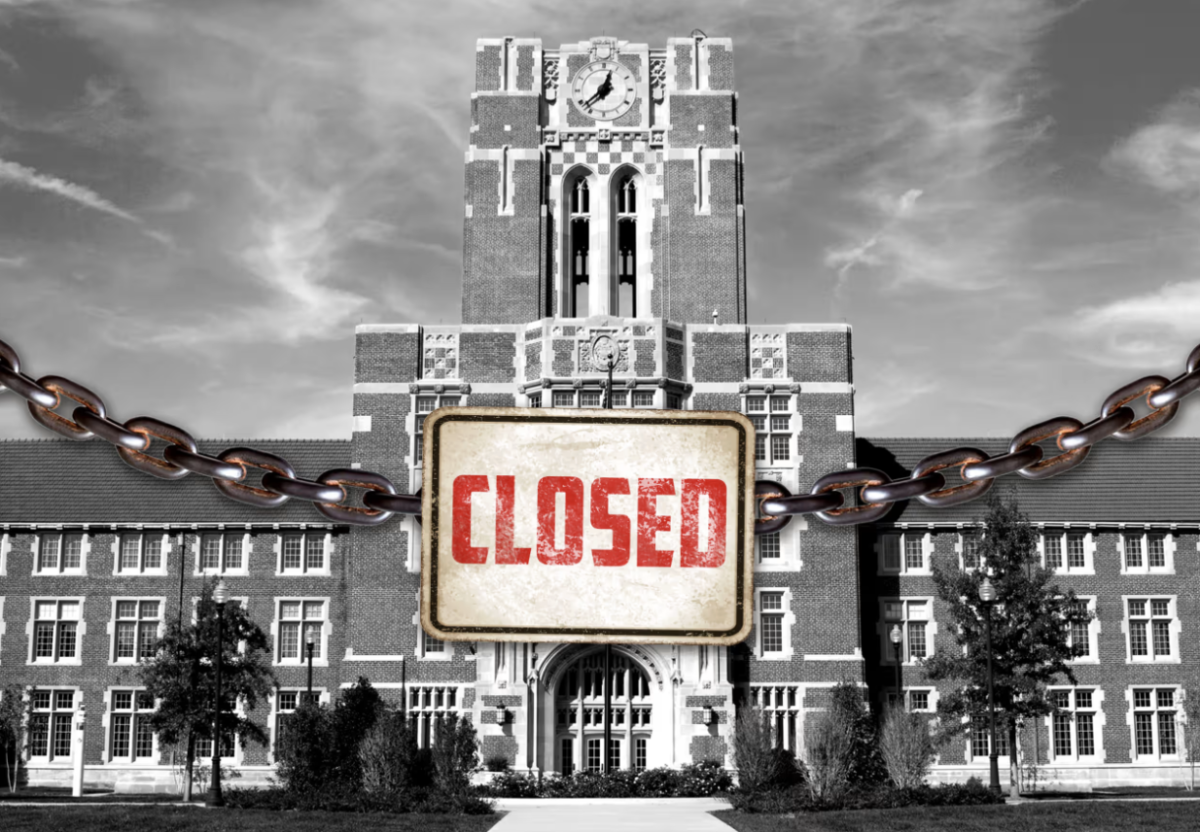
A recent projection from the Huron Consulting Group revealed that nearly 442 private non-profit colleges will close in the coming decade, a prediction that has left the world of higher education spiraling.
There are numerous reasons behind these closures, one of the largest factors being a decline in US birth rates. This decline began in 2008—a result of the 2008 housing crisis—and has continued ever since. This drop translates to fewer students able to apply to colleges than in years past, an issue that is likely to persist until 2041.
In addition, there has also been a recent decrease in foreign student enrollment. As a part of the Trump administration’s broader crackdown on immigration, President Donald Trump and his team have revoked almost 2,000 student visas as of late 2025, mainly on the grounds of small legal infractions such as minor encounters with the police or a DUI. While taking away a student’s visa would usually only affect their ability to re-enter the US if they chose to leave the country, the Department of Homeland Security (DHS) may now begin classifying those with revoked visas as subject to deportation. Another new, perhaps more damaging policy created by the administration allows students’ SEVIS, or Student and Exchange Visitor Information System, to be erased. The deletion of a student’s SEVIS, which can be done as a response to low-level crimes committed by a student, would make them both unemployable and unable to continue their education. These policies, as well as other issues such as general inflation, led to a 17 percent decrease in new foreign student enrollment for the 2025-2026 school year.
This decrease coincides with a drop in domestic student enrollment, with recent data suggesting a nine percent decrease in the number of college applicants from 2016 to 2023. One of the biggest factors in this shift is the current cost of higher education, a price that continues to increase due to inflation as well as colleges’ continued expansion. Universities have also been weathering recent federal cuts to their programs, with the American Council for Education stating that the Trump Administration has frozen grants and funding given to colleges for research in fields such as technology and healthcare. This lack of funding greatly impacts colleges and universities, often exacerbating pre-existing financial issues. Even well-known and highly prestigious universities like Northwestern and Stanford have had to lay off hundreds of employees in the past few years due to low operating funds.
Recently, there has also been an increase in the number of Americans who view higher education as “not that important,” according to a recent Gallup poll; 24 percent of people agreed with this statement as of 2025, an 11 percent increase from 2019. This drop could be attributed to multiple factors, one of which is that many graduates struggle to find jobs after finishing school. While Americans may view this as a failure on higher education’s part, USC Rossier’s School of Education attributes it more to the state of the economy and an overall difficult job market. Mr. Friedler, a guidance counselor at Horace Greeley, affirmed that a college degree still gives students a major edge when it comes to employment: “Things like an alumni network, research, experts in fields, labs, internships…the opportunities are definitely there.”
Besides the reasoning behind them, college closures also have major impacts on students. Less than half of the students who attend a college that ends up closing continue their education at another institution, and of those who do continue their education, less than half actually graduate. Many of the colleges marked for closure are also small, local colleges. This means that their closure would not only impact local economies by eliminating an active group of customers, but also decrease the number of people who return to the community to work after graduation. Besides classes, closures also disrupt the life skills and self-growth that often accompany the college experience. Ryan T., a Greeley alum currently in his junior year at Northeastern University, attested, “I think I’ve grown a lot as a person since starting college. You learn a lot just from living on your own and making your own decisions.”
Even if student demand does increase, colleges marked for closure will still be unable to continue operating at their normal capacity. Instead, the Huron Consulting Group recommends that these colleges consider either consolidating their own programs or merging with another institution. While these options are far from perfect and would still impact attendees, Huron asserts that, in being proactive against closures, more institutions will be able to keep their doors open and continue to welcome students into their schools for years to come.