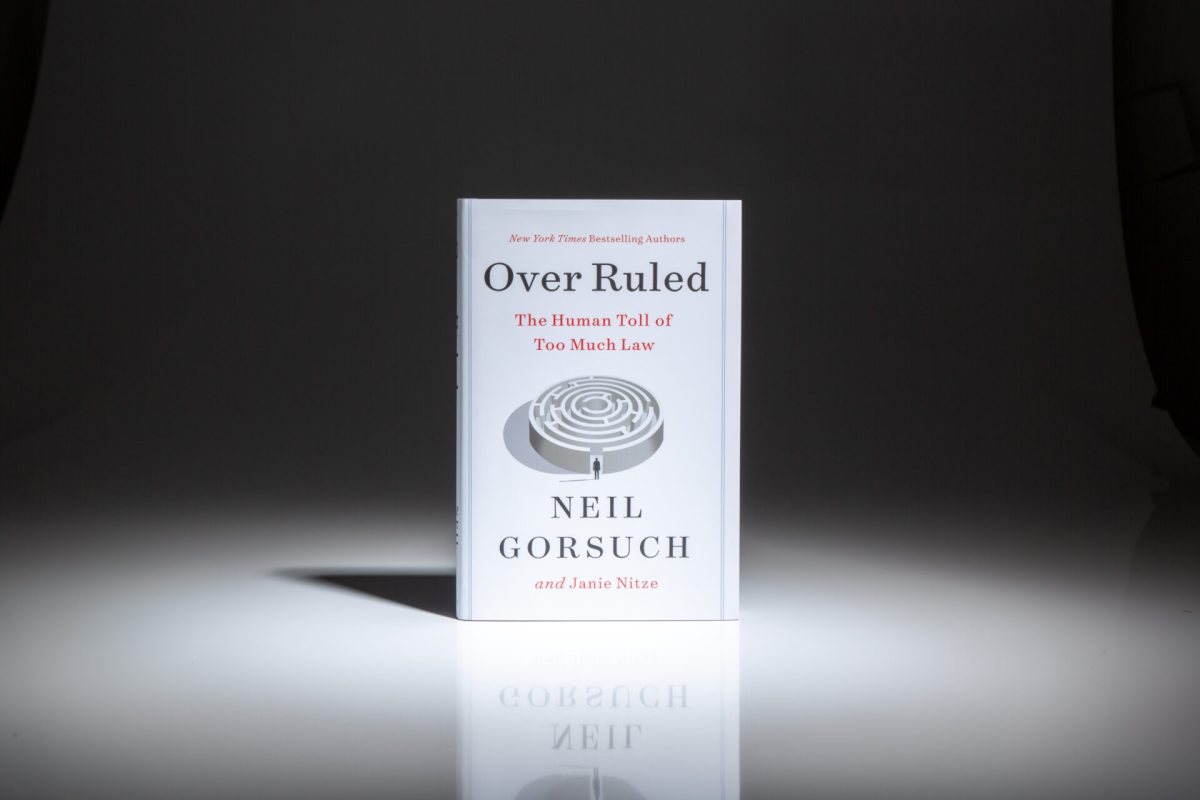
For many people, when they hear someone recommending a book about law, they might immediately assume that it is too complex for them to understand. Laws control everything, from what temperature ketchup must be made to who is allowed to make caskets, and even what counts as a sandwich. In Over Ruled: The Human Toll of Too Much Law, Supreme Court Justice Neil Gorsuch tells real people’s stories to show how laws affect everyone, in a clear, non-legalese way.
One of his stated goals when writing the book was to make it as accessible as possible. He avoids using words like stare decisis or jurisprudence; rather, he makes the book about people’s stories and how they were affected by laws that the layman, and even some government officials and agencies, he argues, are unable to comprehend. He illustrates this by showing how the U.S. Code, the collection of all U.S. laws, has increased exponentially in recent decades: Growing from being able to fit in a single binder to now needing a whole bookshelf.
Hopefully, I have not made this book sound too boring; that is not my goal by writing this review and recommending the book. The legal details are minimal, used only to show how absurdly some laws are applied.
One of the stories that he recalls involves a fisherman named John Yates. While out fishing one day, a federal agent boarded his boat and was determined to measure every red grouper he had caught to make sure that none of the fish were undersized. He found, according to Gorsuch, 72 undersized fish (possibly due to how he measured them) on the day he boarded the boat, but when he returned the next day, he only found 69. Months later, federal agents arrived at his house and told him that he had been charged under the Sarbanes–Oxley Act, a federal law passed after the Enron accounting scandal, making it illegal to destroy “tangible objects” that are under federal investigations. The government alleged that he had destroyed three of the fish. Now, how does this law, passed to prevent companies from destroying spreadsheets and shredding tax documents, relate to fishing? Justice Gorsuch doesn’t know. Mr. Yates’s case would eventually make it up to the Supreme Court, where they would rule in his favor only by the slimmest of margins: 5-4.
Again, this is just one example of the real consequences that the law in this country has on all of us. In fact, due to the sheer volume of complex regulations, one of the statistics that Justice Gorsuch cites is that the average American breaks about three federal laws each day.
This book is not political and should be enjoyed by people across the political spectrum. It’s a book I recommend if you’re interested in how the law affects normal, everyday, hard-working Americans just trying to get by.