
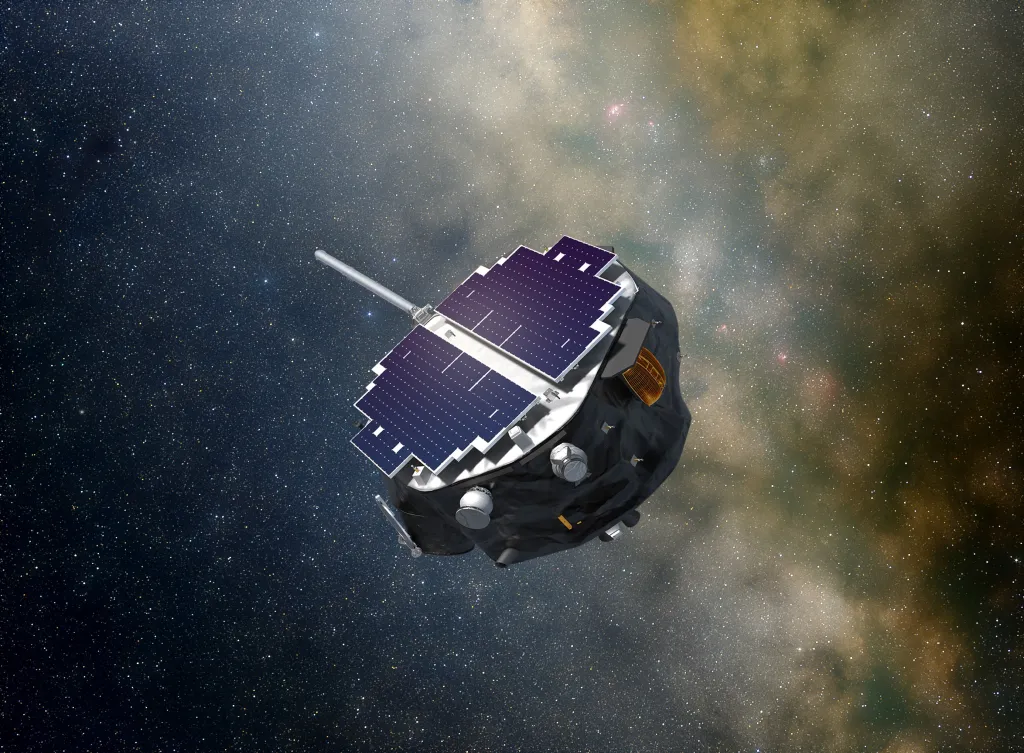
NASA has launched over 1,000 space missions over the last 70 years, including Apollo 11, which landed the first humans on the moon, and some more obscure missions, such as the Imager Mapping and Acceleration Probe (IMAP).
IMAP is NASA’s current mission, launched on Sept. 24, 2025. It was launched on a SPACEX falcon 9 rocket—the world’s first reusable rocket, prototyped in 2010. This mission was similar to an older version launched in 2000, called Imager for Magnetopause-to-Aurora Global Exploration. Both missions were sent for similar purposes: to image Earth’s magnetosphere and heliosphere.
Earth’s heliosphere is a gigantic magnetic bubble, made by the Sun’s solar wind, which protects the entire solar system from interrupting cosmic rays and particles. The purpose of the IMAP mission is to study and map the heliosphere as well as to create a better understanding of the protection of the heliosphere to Earth and how it changes according to the Sun’s activities. Positioned 1 million miles from Earth, IMAP provides a clear view of solar winds and the heliosphere boundary. This mission will also provide data on the solar winds, which helps improve predictions of the impacts of space weather on the health of voyaging astronauts. Because of this mission, NASA’s Mara Johnson-Groh says, “[H]umanity is set to get a better look at the heliosphere than ever before.” The IMAP mission is also a way to build on NASA’s previous missions in 2012 and 2018—the Voyager and IBEX. Also known as the twin voyager, these missions were the first human-made objects to ever cross the heliosphere boundary. Now, IMAP continues their legacy, gathering unknown information about the heliosphere.
As technology progresses and as NASA launches more missions into space, we continue to gain more knowledge about space and the effects the outside world has on our everyday lives. The IMAP can help predict the weather in space, directly supporting astronauts and connecting humanity with the outer world.



![Snapes, A. [@AndySnapes]. (2023, February 4). Trees in NE USA “Exploding” due to the extreme cold causing sap & water to expand… [Image attached] [Post]. X.](https://thegreeleyvoice.com/wp-content/uploads/2026/03/exploding-trees-900x1200.jpeg)
