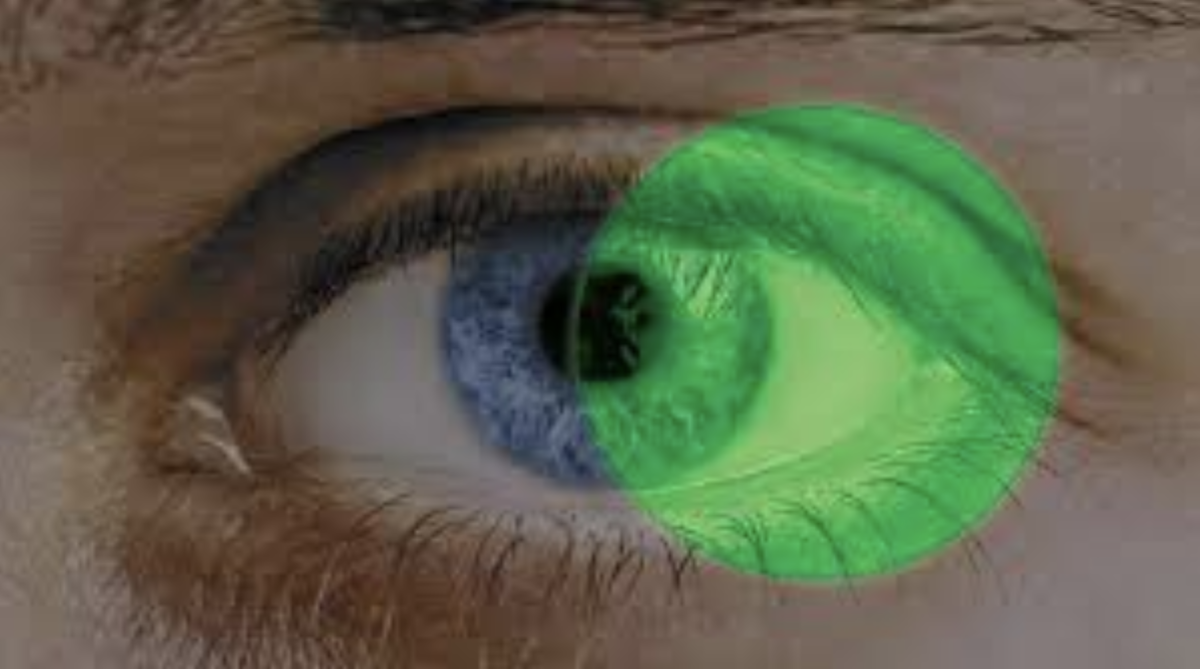
What if humans had super vision? “Over half of the solar radiation energy, existing as infrared light, remains imperceptible to humans,” Dr. Yuqian Ma, a PhD researcher at the University of Science and Technology of China explained, to The Guardian. Though night-vision once seemed impossible, it is quickly becoming reality. With the use of contact lenses, infrared light is being converted to waves visible to the human eye even with eyes closed.
Although night-vision goggles already exist, they contain several limitations, such as only producing images with a monochrome green scale. Contact lenses provide richer, multicolor vision without the need of a power source. The team behind this innovation is the University of Science and Technology in China. Scientific American explains, “[they] gave the lenses power by infusing them with nanoparticles that convert infrared light in the 800-1,600 nanometre range into shorter-wavelength, visible light that humans can see, in the 400-700-nanometre range.”
Night-vision is not just a “cool” tool – it also has real-world applications. “Night-vision technology means there is not a ‘pause’ at night. It adds a whole other dimension to strategy,” explains Greeley Special Education Teacher, Mr. Clark. Recently, when a U.S. fighter jet was shot down over Iran, superior night-vision technology was critical to the rescue mission. The New York Post writes, “U.S. forces have better night-vision and infrared communication technology than combatants in Iran.” Iran’s lack of night-vision technology put them at a severe disadvantage, forcing Iranian officials to rely on civilians to search for the pilot.
Night-vision contact lenses could also be beneficial in our local community. Think about night driving. Drivers often struggle with intense glare from headlights and reduced visibility on dark and winding roads. “More than half of all traffic deaths occur after dark,” explains PubMed Central. Night-vision contact lenses can improve safety, saving lives locally and around the world. According to Global Sensor Technology, “Infrared night-vision technology has the ability to detect objects at long distances, allowing drivers to anticipate potential obstacles or dangers.” Night-vision technology also works in all weather conditions, with rain and fog posing no threat to drivers.
Despite its potential, night-vision contact lenses face limitations. The technology is not yet widely available, and still needs improvements. Currently, these lenses only pick up light projected from LED sources, which are incredibly bright. Scientists believe that if they can develop upconversion nanoparticles with higher efficiency, it may be possible to see surrounding infrared light using contact lenses.
Overall, night-vision contact lenses and night-vision technology have a very promising future. Their real world uses—for not only professionals but also the general population—are seemingly endless, and will help to ensure safety and security around the globe.


![Snapes, A. [@AndySnapes]. (2023, February 4). Trees in NE USA “Exploding” due to the extreme cold causing sap & water to expand… [Image attached] [Post]. X.](https://thegreeleyvoice.com/wp-content/uploads/2026/03/exploding-trees-900x1200.jpeg)