
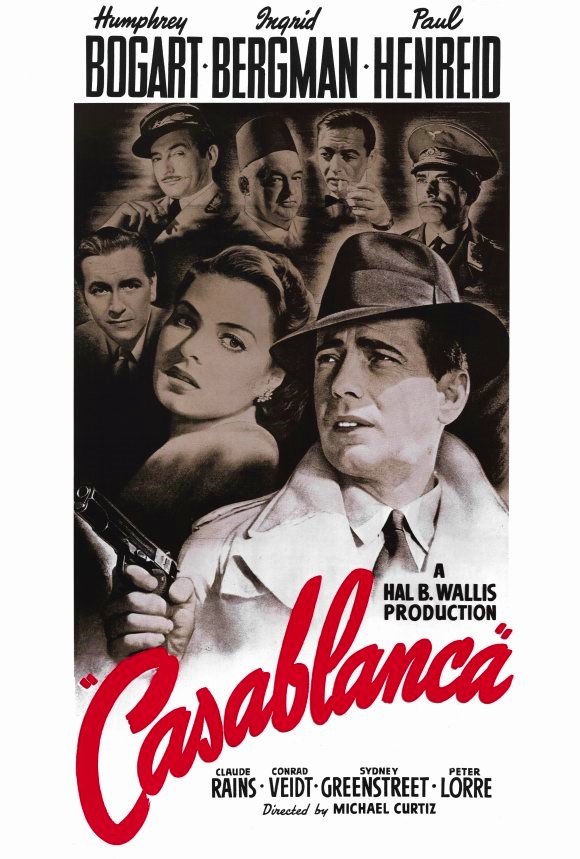
Casablanca (1942), directed by Michael Curtiz is a timeless film which follows a stoic café owner named Rick Blaine (Humphrey Bogart) who navigates love, morals, and alliances. The film is set in the backdrop of World War II in the unoccupied French Territory of Morocco whose government is slowly aligning with the Axis powers. Many Europeans flee to Casablanca—the largest city in Morocco—on their journey to escape to Portugal and eventually travel to the Americas. Rick’s former lover, Ilsa Lund (Ingrid Bergman), unexpectedly arrives with her freedom-fighter husband, Victor Laszlo (Paul Henreid), which forces Rick to confront his past and break out of his neutral, apathetic demeanor. Rick ultimately decides to help the couple escape, sacrificing his personal happiness while recognizing that duty and resistance are what is truly important in this dire wartime setting.
I enjoyed this film very much and understand why it has remained popular since its release over 80 years ago. Powerful, dreamy, cinematic music reflects the drama of each scene, especially whenever Rick and Ilsa are together. The lighting in this film is also very strategic, framing characters faces with shadows whenever they appear to have disagreeing or apprehensive thoughts about the events in the scene. Additionally, I find it fascinating that this film was shot in 1942, during the war itself. While watching, I was able to pick up on some subtle motifs and metaphors that reflected people's opinions of the war. For example, in the scene where the Nazis begin singing a German patriotic anthem in the café, Victor Laszlo instructs the band to play La Marseillaise, the national anthem of France. This evokes an emotional response for many of the people in the café, and they stand up and sing the French anthem loudly, drowning out the Germans. This scene depicts a group of people uniting to resist Nazi power, demonstrating their undying support for the Allies. The film itself can be described as wartime propaganda, as it influenced American public opinion of the Nazis by highlighting their evil nature. However, I believe that makes it all the more interesting to watch because it makes one understand how people felt about the war while it was happening. All aspects of the film were well done and I would like to watch it again someday. Ultimately, it reveals the idea that sometimes one has to make choices they don't want to make, but it will be for the best in the long run. Overall, Casablanca is a legendary classic and I would recommend it to anyone who wants to learn more about lesser known aspects of WWII through a cinematic lens. For these reasons, I rate this movie a nine out of ten.