
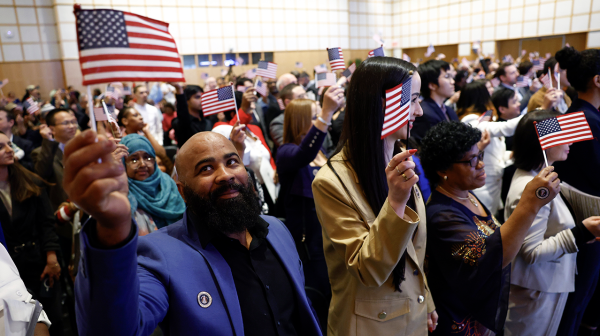
The concept of an alien invasion has elicited fear from society for generations, yet we have never experienced something even close to that of a foreign species permeating the world at large. Thus, several nations have sculpted the narrative that immigrants are equivalent to “alien citizens” (Franz, 2015, p. 184). United States immigration policies are rooted in the 14th Amendment, allowing for thousands of migrant women to give birth to children who can leverage the nation’s opportunities to set themselves up for the best possible future. However, these first-generation children will face a lifetime of animosity and Othering for circumstances they cannot control. It is evident that despite the United States Constitution’s protection of political rights for “anchor babies,” which are babies deliberately born from migrant mothers for the purpose of gaining indirect rights to U.S. citizenship, social protection for immigrants or those descended from immigrants still severely lacks. In 1884, the United States Supreme Court was presented with a case by the name of Elk v. Wilkins in which, “[T]he Court ruled that John Elk, a Winnebago Indian born on an Indian reservation but who later lived within the U.S. territory in Omaha, Nebraska, was considered a member of ‘alien nation’, though ‘in geographical sense born in the United States’, but who cannot be deemed a U.S. citizen…” (Kim, 2017, p. 315). Dating back to the very beginning of the United States settlement, Europeans kicked First Nations off their very own land, and this continued throughout time, as seen in this court case, proving the idea that one does not have to be an immigrant to be considered “alien,” but rather just has to be slightly different. U.S. immigration policies are rooted in the 14th Amendment, allowing for thousands of migrant women to give birth to children who can leverage opportunities to set themselves up for the best possible future. However, these first-generation children will face a lifetime of animosity and Othering for circumstances they cannot control. It is evident that despite political rights for “anchor babies,” which are babies deliberately born from migrant mothers for the purpose of gaining indirect rights to U.S. citizenship, are protected under the United States Constitution, but social protection for immigrants or those descended from immigrants still severely lacks
Upon analyzing the severity of the discrimination of anchor babies, it is made evident that birthright citizenship is only a mildly effective argument for inclusion. American poet, scholar, and cultural critic Deborah Paredez’s Selenidad and Latinidad in the 1990s uses the life of singer-songwriter Selena to investigate the cultural significance of Latina icons in the United States after death (August 2009). The “exotic appeal” of these foreign-born stars after their death emphasizes the lack of acceptance of foreign persons until there is a reason to accept, idolize, or acknowledge them. Similarly, Pulitzer Prize winner Rachel Ghansah explores this idea in My Mother’s House, emphasizing that growing up Black in a white-dominated nation left her with a distorted view of what it means to be “American” (2012). Finding an American Identity in a divided America proves to be one of the most difficult tasks following the historical repression of immigrants, dating as far back as enslavement.
Throughout history, different movements have helped to shape the narrative regarding immigrants. From 1492-1874 the nation’s policy for immigration was incredibly lax, but as time went on exclusion laws and centralized control began (Ewing, 2012, p. 3). In 1875, the first federal act to exclude a particular group of immigrants was passed, deeming this class “undesirable” as they fell under the category of criminal, prostitute, or Chinese contract laborers. This unique and specific discrimination led to the Chinese Exclusion Act of 1882, which was passed by President Chester A. Arthur, banning Chinese laborers from immigrating to the United States for 10 years (Archives, 2023). Shortly thereafter, the U.S. Immigration Service opened Ellis Island in 1892, becoming the nation’s most well-known immigration station (2025). By the 1960s, the societal attitude towards immigration was essentially cemented, having a resurgence as a part of the New Social History (Gjerde, 1999, p. 58). This trend has continued with a growing distrust of foreigners due to political speeches, social media posts, and other forms of information spread.
With the recent developments in technology and social media, phones have become the primary source of communication. Public attitudes towards immigration have become increasingly shaped by the media (De Coninck, et al., 2021, p.6). One example of this is the hit TLC franchise 90 Day Fiance, which details international couples who meet online deciding within 90 days if their foreign fiance will join them in America. The show poses the question of how reliable international relationships may be when a Visa is involved. Rather than the stakes being imposed upon the couples by the producers, the federal government manufactures these ideas, creating even more tension regarding the issue (Gupta, 2020). Much like online international dating, presidential speeches contribute to the growing divide between natural-born and immigrant citizens. During President Donald Trump’s first campaign in 2016, his discussion of immigration stirred up controversy, spreading like wildfire through the media. In his third and final presidential debate for the election, President Trump claims that the United States has some “bad hombres” among us, directly characterizing Latino men as threats who are engaged in criminal behavior (Mohammed and Farris, 2019, p. 2).
In returning to the birthright citizenship argument, it can be found that family unity is put at risk. Under the Trump administration’s reforms, U.S. Immigration Customs and Enforcement (ICE) has separated families. These reforms beg the question of the extent to which United States immigration policies and intolerance fail to acknowledge the loopholes like birthright citizenship About 68% of family migrants (45% of total migrants) are immediate relatives of U.S. citizens, and are, “…admitted without numerical limitations under the total 480,000 cap” (Gubernskaya and Dreby, 2017). Family-friendly provisions and an emphasis on promoting family unity have become more prevalent over time, but the attitudes towards first-generation children have hardly seen a shift. Donnaloja and Vink analyze the impact of immigrant population growth on citizenship rights to children of immigrants that hold birthright citizenship, finding in their studies that respondents are more likely to be in favor of birthright citizenship in cases where the parent is stable financially, socially, or another defining societal aspect (November 2023). Ultimately, the United States policies for immigration severely lack acknowledgement of loopholes like birthright citizenship, enhanced consistently by way of the media, contributing to the issues our nation is presently facing in this regard.
Some argue that the United States has grown more tolerant of immigrants as a result of the growing prevalence of DEI, as “…natives’ attitudes and national policies shape the warmth with which immigrants are received and potentially shape immigrants’ identities” (Fussell, 2016). Yet, this is entirely untrue, as there seems to be a clear distinction between what are known as “real citizens” and what are known as “alien citizens,” meaning that those born from American-born citizens versus those born from immigrants hold different rights socially. This distinction stems from a centuries-old intolerance towards immigrants (Franz, 2015).
The United States has been inconsistent in its measures to protect and control citizens. The U.S. Department of State’s interpretation of Citizenship Clause 1 of the 14th Amendment, which ensures that all “persons born or naturalized in the United States, and subject to jurisdiction thereof, are citizens of the United States’, including the children of unauthorized immigrants,” but the path the department took to get there was relatively unstable (Sullivan, p. 66). Employer at the University of North Carolina Department of Communication Studies, Margaret Franz hypothesizes that “anchor babies” are constructed as inheriting their parents’ racialized illegality, contradicting the seemingly objective interpretations of the Amendment. Despite their actual legal status as Americans under 14th Amendment rights, there is an umbrella cast upon birthright citizens that allows for migrant mothers to have “anchor babies.” In fact, Franz illustrates that national love and national fear work together to create the spectre of “citizen terrorism,” which ultimately functions to help many individuals attempt to reinterpret the 14th Amendment (Franz, 2015, p. 186).
There are various concepts that remain undiscussed with regards to the argument for birthright citizenship. These citizens do have rights within the United States, and they will one day grow into workers, taxpayers, neighbors, and leaders whose contributions will help strengthen the nation economically, culturally, and politically (Kim, 2017). In terms of politics, the political rhetoric and fear-based narratives currently dominate the nation’s definition of who is a citizen, in large part due to the extremely polarized political climate that currently permeates the United States (U.S. Citizenship and Immigration Services, 2020). This political discourse weaponizes fear and distorts public understanding of birthright citizenship for electoral gain. Likewise, the economic benefits of immigrant children cannot be overlooked due to their magnitude: the economic contributions of anchor babies directly contradict the notion that they drain our resources. The need to recognize that American identity has always evolved through immigration is now greater than ever, as birthright citizenship is central to national values in that the 14th Amendment established that citizenship must not be defined by race, lineage, or circumstances of one’s birth. In this way, birthright citizenship continues to serve as a reminder that American identity is not inherited but created, upheld by shared values rather than ancestry. By upholding birthright citizenship, the United States honors its foundational belief that every person born here has the right to belong, contribute, and thrive, yet societal attitudes still obstruct these rights.
Ultimately, it can be argued that the various forms of information spread in combination with political affairs have contributed to the ill reception of immigrants in the United States. The motives for which one may come to the country—to have children, to get married, to reap economic benefits—are plenteous, but the common theme is the societal acceptance of these new citizens, or lack thereof. Clearly U.S. immigration policies lack political structure and acknowledgement of any possible loopholes that are otherwise addressed socially, so in order to progress as a nation with regards to this issue, we must implement regulations of who comes in and out of the country to a moderate extent. If we take this measure, it will be far easier to understand our country’s population and where we are in terms of resource and land distribution. Likewise, specificity within the 14th Amendment that addresses possible motives for having anchor babies will allow people to truly understand everyone’s rights and work together as a nation towards the betterment of our nation. Instead of promoting negativity concerning immigration, we must aim to honor and accept the rights of all individuals which are entitled to equal protection and treatment. This will foster a stronger sense of national pride and conclusively strengthen the world at large.
Works Cited
De Coninck, David, et al. “Public Attitudes towards Immigration, News and Social Media Exposure, and Political Attitudes from a Cross-Cultural Perspective: Data from Seven European Countries, the United States, and Colombia.” Data in Brief, vol. 39, Dec. 2021, p. 107548, https://doi.org/10.1016/j.dib.2021.107548. Accessed 15 Nov. 2021.
Donnaloja, Victoria, and Maarten Vink. “Like Parent, like Child: How Attitudes towards Immigrants Spill over to the Political Inclusion of Their Children.” Journal of Ethnic and Migration Studies, vol. 50, no. 14, 20 Nov. 2023, pp. 3435–3452, https://doi.org/10.1080/1369183x.2023.2282388. Accessed 24 Oct. 2025.
Ewing, Walter. OPPORTUNITY and EXCLUSION: A Brief History of U.S. Immigration Policy. 2012.
Franz, Margaret. “Will to Love, Will to Fear: The Emotional Politics of Illegality and Citizenship in the Campaign against Birthright Citizenship in the US.” Social Identities, vol. 21, no. 2, 4 Mar. 2015, pp. 184–198, https://doi.org/10.1080/13504630.2015.1041016. Accessed 17 Apr. 2020.
Fussell, Elizabeth. “Warmth of the Welcome: Attitudes toward Immigrants and Immigration Policy in the United States.” Annual Review of Sociology, vol. 40, no. 1, 30 July 2014, pp. 479–498, https://doi.org/10.1146/annurev-soc-071913-043325.
Ghansah, Rachel. “My Mother’s House.” Transition, vol. 109, no. 109, 2012, https://doi.org/10.2979/transition.109.3.Jstor
Gjerde, Jon. “New Growth on Old Vines: The State of the Field: The Social History of Immigration to and Ethnicity in the United States.” Journal of American Ethnic History, vol. 18, no. 4, 1999, pp. 40–65. JSTOR, www.jstor.org/stable/27502470, https://doi.org/10.2307/27502470.
Gubernskaya, Zoya, and Joanna Dreby. “US immigration policy and the case for family unity.” Journal on Migration and Human Security, vol. 5, no. 2, June 2017, pp. 417+. Gale Academic OneFile Select, link.gale.com/apps/doc/A499916612/EAIM?u=nysl_me_hghsl&sid=bookmark-EAIM&xid=2e862a46. Accessed 6 Nov. 2025.
Gupta, Prachi. “AN AMERICAN LOVE STORY: The hit show 90 Day Fiance shines an unsparing light on America’s fascination with marriage and anxiety about immigration.” Marie Claire, fall 2020, pp. 157+. Gale General OneFile, link.gale.com/apps/doc/A646800651/ITOF?u=nysl_me_hghsl&sid=bookmark-ITOF&xid=6921a958. Accessed 6 Nov. 2025
Kim, Joon K., et al. “Genderacing Immigrant Subjects: “Anchor Babies” and the Politics of Birthright Citizenship.” Social Identities, vol. 24, no. 3, 18 Sept. 2017, pp. 312–326, https://doi.org/10.1080/13504630.2017.1376281. Accessed 24 Oct. 2025.
National Archives. “Chinese Exclusion Act (1882).” National Archives, 17 Jan. 2023, www.archives.gov/milestone-documents/chinese-exclusion-act.
Paredez, Deborah. Selenidad: Selena, Latinos, and the Performance of Memory. Duke University Press, 2009. JSTOR, https://doi.org/10.2307/j.ctv11689wt. Accessed 24 Oct. 2025.
Silber Mohamed, Heather, and Emily M. Farris. ““Bad Hombres”? An Examination of Identities in U.S. Media Coverage of Immigration.” Journal of Ethnic and Migration Studies, vol. 46, no. 1, 10 Feb. 2019, pp. 1–19, https://doi.org/10.1080/1369183x.2019.1574221.
Sullivan, Michael. “PROTECTING MINORITIES from de FACTO STATELESSNESS: BIRTHRIGHT CITIZENSHIP in the UNITED STATES.” Statelessness & Citizenship Review, Suppl. Children and Statelessness Special Issue, vol. 4, no. 1, pp. 66–87, www.proquest.com/docview/2901539745/88FED82C2FA493DPQ/1?sourcetype=Scholarly%20Journals.
U.S. Citizenship and Immigration Services. “Origins of the Federal Immigration Service | USCIS.” Www.uscis.gov, 30 July 2020, www.uscis.gov/about-us/our-history/explore-agency-history/overview-of-agency-history/origins-of-the-federal-immigration-service.