
Adolescent loneliness has become a crisis in the United States. The U.S. Surgeon General’s 2023 advisory on social connection reveals that youth isolation is a defining public health emergency, warning that a lack of social connection causes health risks equivalent to smoking to smoking up to fifteen cigarettes per day and is associated with a 29% increased risk of heart disease, a 32% increased risk of stroke, and a roughly 50% increased risk of dementia (Office of The Surgeon General). Despite the extremeness of this crisis, little has been done to intervene. Twenge et al. found that adolescent school loneliness increased in 36 out of 37 countries between 2012 and 2018, a rise correlated with the widespread adoption of smartphones and increased digital use. The widespread scale and high speed of this trend reveal that technology-based social life is not assisting with adolescents’ relationship needs.
Against this problem, a lot of research points to an overnight summer camp as an effective intervention. Ferreira et al. 's work on third places (shared physical spaces outside home and school) demonstrates that structured environments designed for human interaction reduce isolation and build community. This raises the question: To what extent does participation in overnight summer camp reduce social isolation and encourage lasting social connections in American adolescents? Summer camp, with its communal living spaces, collaborative activities, and removal from the digital world, is possibly one of the best third places available to American adolescents. Participation in overnight summer camp significantly reduces social isolation and fosters lasting social connections in American adolescents, due to the fact that camps are structured to prioritize social and emotional development, cultural connection, and fair access. The evidence establishes that camp is not a luxury activity, but a meaningful structural response to a national crisis.
Before evaluating summer camp as an intervention, it is essential to establish the severity and scope of the problem it addresses. Twenge et al. conducted an analysis using PISA data from over half a million adolescents across thirty-seven nations. Their findings all correspond to the idea that school loneliness nearly doubled globally between 2012 and 2018, with girls experiencing larger increases than boys. Economic variables such as unemployment rates and income inequality did not predict these increases, but increased use of smartphones and the internet did. As the researchers note, "Worldwide, nearly twice as many adolescents in 2018 (vs. 2012) had elevated levels of school loneliness." (Twenge et al., p. 1). This correlation reflects a fundamental shift in how adolescents spend their time and form relationships, with increasing digital use substituting for face-to-face interaction that is essential.
The health consequences of this shift are severe. The Office of the Surgeon General established that social connection is biologically required for human survival. For adolescents specifically, the Surgeon General conveys that social isolation dramatically elevates risk of depression, heart disease, stroke, and dementia, conditions typically associated with adults but increasingly appearing in children. The Surgeon General specifically calls for the creation of structured environments that rebuild human connection, framing the epidemic of loneliness as a failure requiring solutions, not solely individual behavior change.
These problems are essential for understanding summer camp’s potential. If social isolation among adolescents is due to the structure of the world today, then the solution must be the construction of spaces and experiences that prioritize belonging, relationships, and face-to-face interactions. This is precisely what summer camp provides.
Ferreira et al.’s research on coffee shops as “third places” (spaces separate from home and school that allow social interaction and communication) provides information that reveals how summer camp works. Ferreira et al. found that 85% of the independent coffee shops that they studied hosted regular group meetups. Even brief interactions within these shops (like a barista remembering your order) can create a sense of belonging. Participants in these spaces reported stronger senses of belonging and deeper social bonds than those who spent time in non-structured environments. The researchers argue that third places are producers of social life, but the design, culture, and environment of a space shape whether genuine connection or only proximity happens. This distinction is critical because it explains why simply putting adolescents near others (such as in schools or online spaces) is insufficient, and why intentionally structured environments like summer camp are more effective at producing meaningful connections.
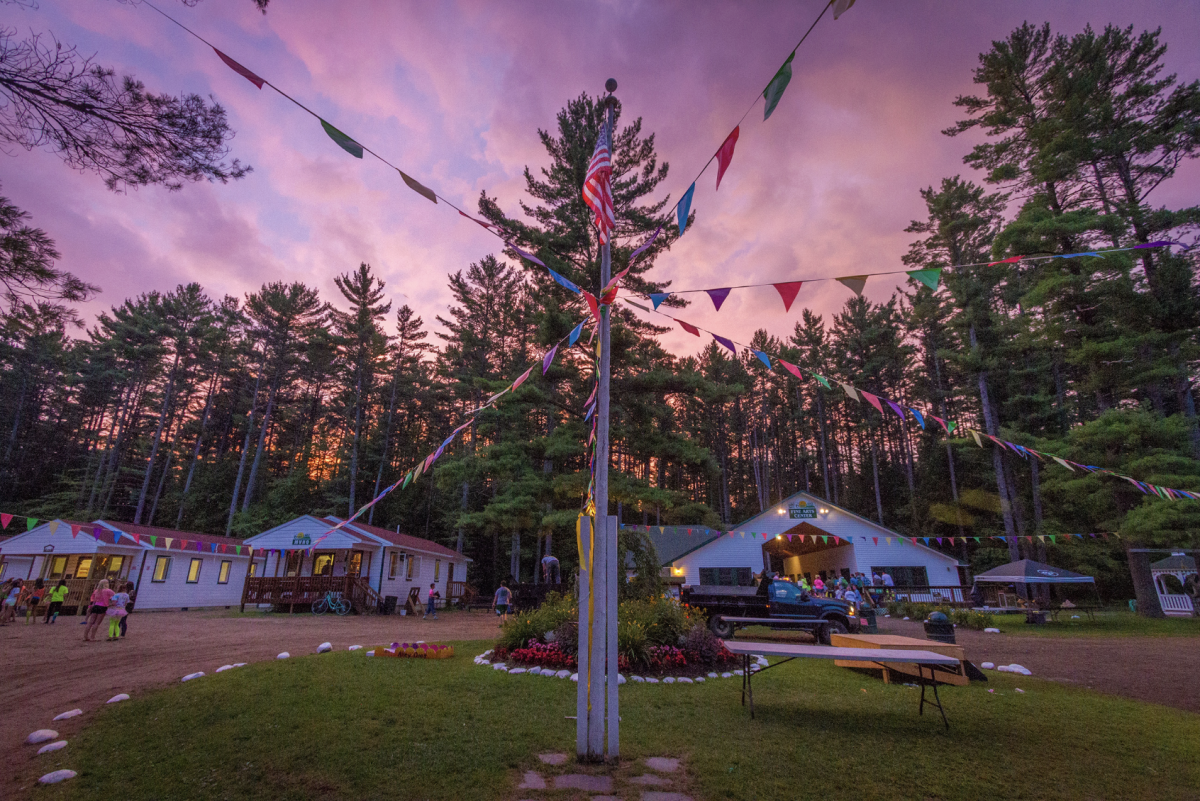
Summer camp creates opportunities for these principles in an enticing, encouraging format unavailable in any other context for adolescents. Unlike a coffee shop, camp provides not hours but weeks of shared living: collective meals, sleeping in the same cabins, collaborative activities outside, and constant interaction with a group. Trotzsky et al. examined the psychological mechanisms underlying these experiences, placing overnight camp in the context of a public health intervention for adolescent mental health. Their analysis found a significant decrease in anxiety symptoms after camp compared to pre-camp levels, along with significant increases in positive emotion and self-confidence. The authors identify four specific therapeutic mechanisms: removal from technology, a new group of peers without prior social hierarchies, community living, and consistent adult oversight, which are all structural features of the camp environment.
Spielvogel et al.’s study of 277 adolescent camp participants provides evidence for how camp builds lasting emotional intelligence. The researchers examined how the quality of developmental experiences at both camp and school predicted growth in empathy over time. Their findings revealed that higher quality experiences at camp predicted empathy gains, and that camp and school experiences were mutually reinforcing benefits from one carried into the other. Youth who reported abundant developmental experiences at camp showed empathy increases that were 0.27 standard deviations higher than peers with weaker experiences, even after controlling for prior empathy levels. This confirms that camp is not guaranteed as beneficial but is most helpful when it includes the depth that Ferreira et al. identify as important for true third places.
Berry et al.’s study on structured nature experiences (SNEs) at camp reveals further evidence. The researchers found that adventure activities (ropes courses, hiking, kayaking) produced the strongest social outcomes, including improved self-esteem, communication skills, and sense of belonging. As Berry et al. describe, “the opportunity to share mutually exclusive space and take part in fun recreational activities together contributed to the campers' level of social connectivity and feelings of belonging" (Berry et al.). Shared experiences and group problem-solving are conditions that schools and digital environments rarely provide, but that camp creates specifically.
A main question about the effects of summer camps is whether their positive effects persist beyond the program itself. Evidence on the long-term effects of summer camps is very encouraging. Warner et al.’s study of 744 former campers (taken from four different camp types) found that relationship skills and sense of belonging were the most frequently listed lasting outcomes, reported as important to daily life years after camp attendance. The consistency of these outcomes across general, arts, sports, and medical specialty camps suggests that the benefits of camp are fundamental features of the camp environment itself.
Most interesting among Warner et al.’s findings were the results for medical specialty camps, which serve adolescents with chronic illnesses, who often experience social isolation due to their conditions. These campers reported that camp gave them an irreplaceable sense of belonging and normalcy, unavailable in other contexts. One participant explained, “Having a chronic illness at a young age often means you can’t relate to other kids. It was an amazing feeling like I belonged for once” (Warner et al.). This statement powerfully conveys that for adolescents whose isolation is something built into their reality, camp provides social life that doesn’t otherwise exist.
The historical record reinforces camp as a stable institution for belonging. Mykoff’s historical analysis of Jewish summer camps in the United States documents that from the early twentieth century onward, camps were deliberately designed not only designed for entertainment but to develop the “total child:” socially, emotionally, and culturally. Mykoff states, “The routines that structured summer camp days and nights nurtured a strong sense of belonging to a Jewish community” that extended far beyond the summer months, influencing participants’ identities and social life well into adulthood (Mykoff).
The limitations of summer camps must also be described to temper the enthusiasm of its benefits. The most significant challenge to a claim about camp’s effectiveness comes from the fairness research within several studies. As Smith et al. document, white youth are overrepresented by approximately 50% in American summer camps, while low-income youth of all racial and ethnic groups are underrepresented by roughly the same margin. This means that the population most likely to benefit from camp (adolescents facing poverty-related social isolation, whose access to third places and other activities is already extremely constrained) is least likely to attend.
Furthermore, Smith et al.’s analysis of three camp types for Black and Latinx middle schoolers found that not all camp structures produce positive outcomes. Education camps produced small negatives on wellbeing, recreational camps showed neutral or mixed results, and only integrated camps (which combined structured social-emotional learning with outdoor experiences and strong adult relationships) produced consistently positive outcomes. This finding complicates Berry et al.’s claim that adventure activities reliably build social connections. The structural quality of the program shapes whether any activity, including outdoor activities, produces the belonging Ferreira et al. identify as a true third place. Also, Povilaitis et al’s study of early departures from a nonprofit camp for low-income youth found that campers with documented behavioral, developmental, or mental health concerns were 52% more likely to leave camp before completing their session, and that high camper-to-counselor ratios increased this risk. This directly challenges Trotzky et al. 's identification of removal of technology and communal living as therapeutic mechanisms. If the youth most in need of these benefits are also the most likely to leave before they take effect, then the therapeutic model is incomplete without corresponding attention to staffing. This means that the youth most likely to benefit from camp’s social-emotional outcomes are also the most likely to leave before these outcomes are realized.
However, these limitations do not undermine the argument; they refine it. The question is not whether camp works in general, but which camp works, for whom, and under what conditions. The research consistently points toward the same answer: high-quality, intentionally structured, culturally responsive camp programs reliably reduce social isolation and build lasting social bonds.
The evidence constructed here supports a clear conclusion: participation in overnight summer camp significantly reduces social isolation and fosters lasting social connections in American adolescents, when programs are intentionally structured, culturally responsive, and accessible. Twenge et al. and the Office of the Surgeon General together convey the urgency and large scale of the isolation crisis that the camp addresses. Spielvogel et al., Trotzky et al., and Berry et al. illuminate the specific mechanisms through which high-quality camp produces its effects. Warner et al.’s research confirms that these effects persist beyond the summer, and Mykoff’s historical analysis puts them in the context of a century-long positive track record.
Ferreira et al.’s framework of the third place is the thread connecting all of this evidence: humans need structured spaces that exist outside of their daily routines, that provide more chances to interact with others, and that are designed to produce belonging instead of simply allowing it. Summer camp is, in many aspects, the most fully realized third place in American life. At a moment when the Surgeon General is calling loneliness a national public health emergency, and adolescents are increasingly spending their critical developmental years with devices rather than people, overnight summer camp represents not solely a form of entertainment and a way to keep busy, but a serious, effective intervention. Summer camp is one of the oldest and most effective ways to bring people together, and the research suggests that there will be many positive outcomes if humanity ensures far more young Americans have access to this experience.
Works Cited
Berry, Daniela, et al. “The Influence of Structured Nature Experiences on Youth Mental, Emotional, and Social Health Competencies in Summer Camps: A Systematic Review.” Behavioral Sciences (2076-328X), vol. 16, no. 2, Feb. 2026, p. 246. EBSCOhost, https://doi.org/10.3390/bs16020246.
Ferreira, Jennifer, et al. “Spaces of Consumption, Connection, and Community: Exploring the Role of the Coffee Shop in Urban Lives.” Geoforum, vol. 119, no. 1, 1 Feb. 2021, pp. 21–29, www.researchgate.net/publication/348381227_Spaces_of_consumption_connection_and_community_Exploring_the_role_of_the_coffee_shop_in_urban_lives, https://doi.org/10.1016/j.geoforum.2020.12.024.
Mykoff, Nancy. "Summer Camping in the United States." The Shalvi/Hyman Encyclopedia of Jewish Women, Jewish Women's Archive, 2021, www.academia.edu/50111490/Summer_Camping_in_the_United_States.
Office of the Surgeon General. "Chapter 2: How Social Connection Impacts Individual Health and Well-Being." Our Epidemic of Loneliness and Isolation: The U.S. Surgeon General's Advisory on the Healing Effects of Social Connection and Community. U.S. Department of Health and Human Services, 2023.
Povilaitis, Victoria, et al. "Understanding Why Youth Depart Early from Summer Camp." Journal of Youth Development, vol. 19, no. 3, 2024, Article 5. https://doi.org/open.clemson.edu/jyd/vol19/iss3/5.
Smith, Bradley H., et al. “Comparing Three Overnight Summer Camp Experiences for Marginalized Middle School Students: Negative, Neutral, and Positive Results.” Journal of Experiential Education, vol. 45, no. 2, June 2022, pp. 136–56. EBSCOhost, https://doi.org/10.1177/10538259211030529.
Spielvogel, Bryn, et al. “Empathy in an Ecosystem: A Longitudinal Study Examining Contributions of Summer Camp and School Experiences to Empathy during Early Adolescence.” Applied Developmental Science, vol. 30, no. 1, Jan. 2026, pp. 52–70. EBSCOhost, https://doi.org/10.1080/10888691.2024.2363811.
Trotzky, Z.A., et al. "Treating Anxiety and Depression in Children and Adolescents: The Therapeutic Potential of Overnight Summer Camp." Child & Youth Care Forum, 2025, doi.org/10.1007/s10566-025-09901-4.
Twenge, Jean M., et al. “Worldwide Increases in Adolescent Loneliness.” Journal of Adolescence, vol. 93, no. 1, 20 July 2021, www.sciencedirect.com/science/article/pii/S0140197121000853, https://doi.org/10.1016/j.adolescence.2021.06.006.
Warner, Robert P., et al. “Similarities and Differences in Summer Camps: A Mixed Methods Study of Lasting Outcomes and Program Elements.” Children and Youth Services Review, vol. 120, 1 Jan. 2021, eds.a.ebscohost.com/eds/detail/detail?vid=2&sid=a317d869-ec7d-4b78-9aeb-c6263e0736fa%40sdc-v-sessmgr03&bdata=JkF1dGhUeXBlPXNoaWImc2l0ZT1lZHMtbGl2ZSZzY29wZT1zaXRl#AN=S0190740920322015&db=edselp, https://doi.org/10.1016/j.childyouth.2020.105779.