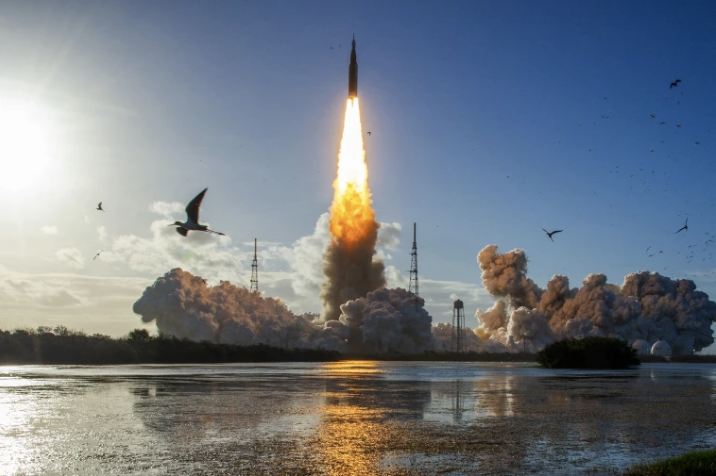
On April 1st, 2026, NASA successfully launched the Orion spacecraft, returning astronauts to the moon’s orbit for the first time in over 50 years. The last time was in 1972 with the Apollo 17 mission. The Artemis II mission lasted 10 days, following a trajectory of 695,081 miles before splashing down off the coast of San Diego. While looping around the far side of the moon, astronauts Reid Wiseman, Victor Glover, Christina Koch, and Jeremey Hansen made history by flying the farthest distance humankind has ever traveled from Earth.
Artemis II is one of five Artemis missions. With these missions NASA hopes to one day gain information to create a permanent base on the lunar South Pole to support scientific research. Creating this base will bring NASA closer to new space travel endeavors, such as the human exploration of Mars. Artemis II is a stepping stone in this plan. This mission allowed astronauts to explore a previously undiscovered portion of the moon, including areas around the far side.
Once Orion reached space, the NASA astronauts went straight to work. Throughout their 10-day mission they worked diligently, as even the smallest errors could have been life threatening. After taking off their orange spacesuits worn for launch, they started arranging the spacecraft to create a functional living and working space for the duration of their trip. Three hours after launch the astronauts docked Orion to another spacecraft to verify its connectivity ability for future missions. Throughout their trip, additional measures were taken to ensure safety such as demonstrating CPR procedures in space. Most importantly, the astronauts recorded their observations of the back side of the moon. During this time they lost communication with Earth for approximately 40 minutes: a risk that made Artemis II like no mission before.
Unlike missions to the International Space Station, Artemis II does not offer quick solutions if a problem erupts, which explains the astronauts’ extensive training. Since June 2023, Reid Wiseman, Victor Glover, Christina Koch, and Jeremey Hansen have been meticulously learning the fundamentals of Orion’s systems, as well as training for a variety of situations. They ran full mission simulations and did field training in places like Canada and Iceland to study landscapes similar to the moon, explained USRA. This was key as the lunar flyby lasted approximately seven hours and accurate identification of findings was necessary. While spending time at NASA’s Johnson Space Center in Houston, the astronauts perfected how to “identify crater shapes, surface textures, color variations, and reflectivity.” These findings are important because, although the astronauts did not land on the moon during this mission, their detailed observations from lunar orbit will help to prepare for future Artemis missions.
There are many components that went into Orion’s trajectory. Orion stayed on track not only due to its engine, but also with the help of different physics laws. Ms. Moore, a Horace Greeley physics teacher explained, “Orion stayed on path due to the universal law of gravitation: two objects experience an attractive force proportional to their masses.” She also stressed the importance of “Newton’s first law[, which] states that objects in motion stay in motion unless acted upon by an external force.” These physics principles allowed Orion to orbit Earth almost twice before needing another thrust to move into the moon’s orbit. Without taking into account the conditions in space and the laws of physics, the Orion journey would not have been possible.
Artemis II splashed down safely off the coast of San Diego on April 10 at 8:07 p.m. The astronauts were quickly retrieved and shown to be in good shape, with Wiseman saying, “What a journey. We are stable. Four green crewmembers.” Given the success of the Artemis II mission, NASA is excited for the continuation of the Artemis program, and hopes to see astronauts land on the moon again by 2028.